Introduction
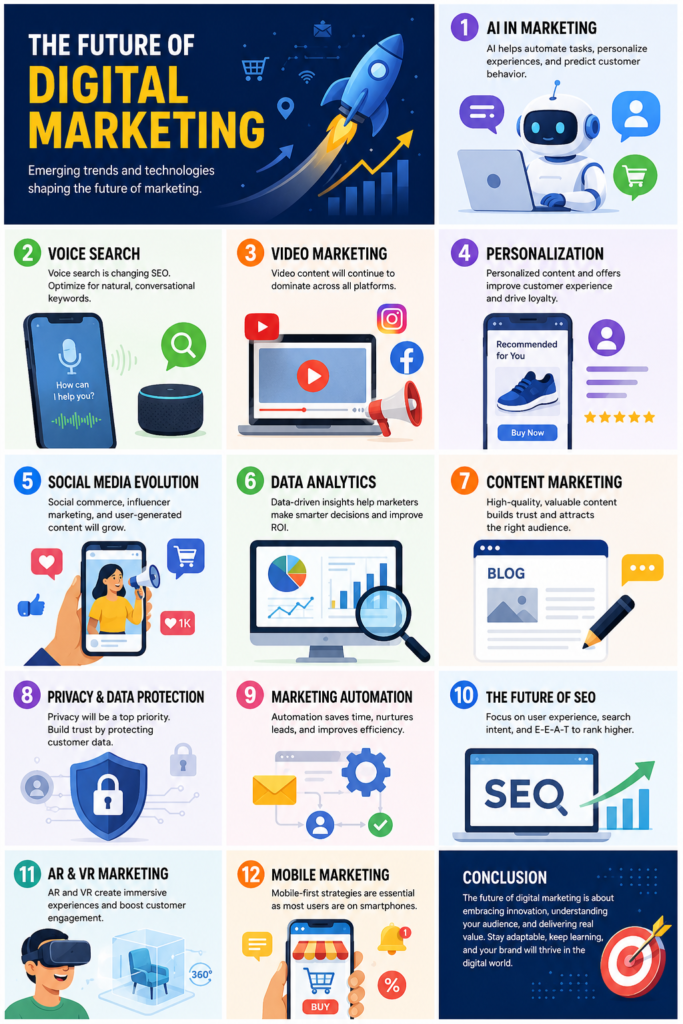
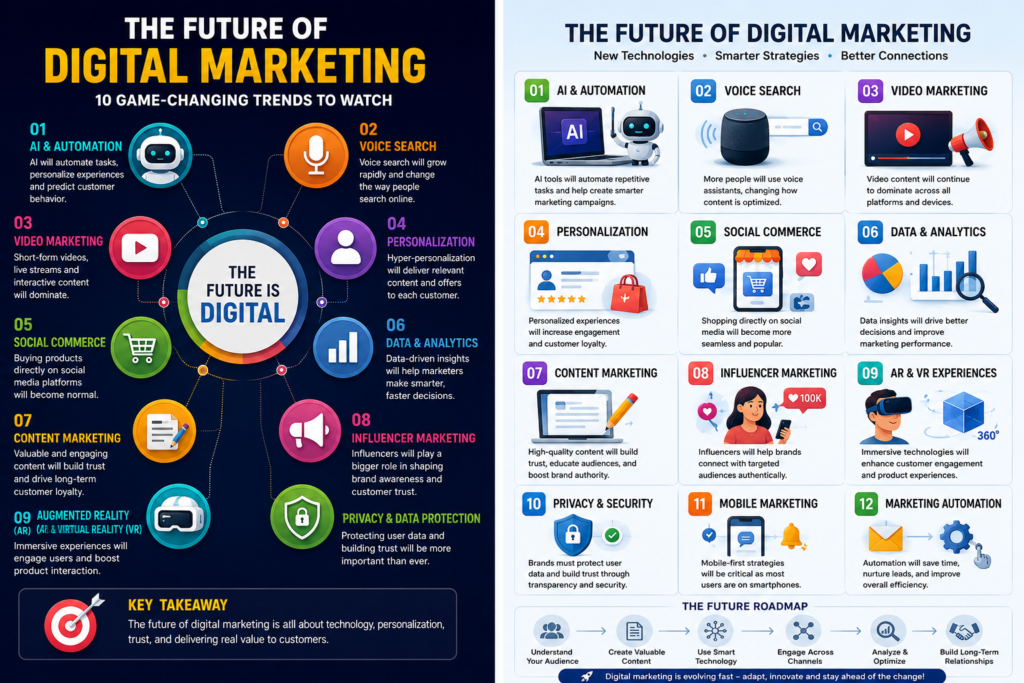
Digital marketing has changed the way businesses connect with customers. From social media campaigns to search engine optimization (SEO), companies now have endless opportunities to promote their products and services online. However, technology and customer behavior continue to evolve rapidly. The future of digital marketing will be driven by artificial intelligence, automation, personalization, voice search, video content, and data-driven strategies.
Businesses that fail to adapt to these changes may struggle to compete, while those that embrace innovation can build stronger customer relationships and increase their revenue. In this blog, we will explore the future of digital marketing, key trends, challenges, solutions, and practical examples that businesses can use to stay ahead.
1. The Rise of Artificial Intelligence (AI) in Digital Marketing
What is AI in Digital Marketing?
Artificial Intelligence (AI) refers to machines and software that can analyze data, predict customer behavior, and automate marketing tasks. AI helps marketers save time and improve campaign performance.
Examples of AI in Marketing
- Chatbots answering customer questions instantly
- AI tools creating social media captions
- Personalized product recommendations on e-commerce websites
- AI-powered email marketing campaigns
Companies like Amazon and Netflix use AI to recommend products and content based on customer interests.
Benefits of AI
Faster Customer Support
AI chatbots provide 24/7 customer service.
Better Personalization
AI analyzes user behavior to show relevant ads and recommendations.
Improved Marketing Decisions
AI tools help marketers understand what customers want.
Challenges
- Privacy concerns
- Overdependence on automation
- Lack of human creativity
Solutions
- Combine AI with human creativity
- Use customer data responsibly
- Be transparent about data collection
2. Voice Search Will Change SEO
What is Voice Search?
Voice search allows users to search the internet using voice assistants like:
- Google Assistant
- Siri
- Amazon Alexa
Instead of typing, people speak naturally when searching online.
Example
Typed search:
“best pizza restaurant Delhi”
Voice search:
“Which is the best pizza restaurant near me?”
Future Impact on SEO
Voice search queries are longer and more conversational. Businesses will need to optimize their content for natural language.
Solutions for Businesses
Use Conversational Keywords
Write content the way people speak.
Focus on Local SEO
Optimize Google Business Profiles and local keywords.
Improve Website Speed
Voice search users expect quick answers
3. Video Marketing Will Dominate
Why Video Content is Growing
People prefer watching videos instead of reading long text. Short-form video platforms are becoming extremely popular.
Popular platforms include:
- YouTube
- TikTok
Types of Video Content
Short Videos
Quick educational or entertaining videos.
Live Streaming
Brands interact with customers in real-time.
Product Demonstrations
Businesses show how products work.
Example
A clothing brand can create:
- Styling tutorials
- Behind-the-scenes videos
- Customer testimonials
Challenges
- High competition
- Time-consuming content creation
Solutions
- Focus on quality storytelling
- Use trending topics and hashtags
- Post consistently
4. Personalization Will Become Essential
What is Personalized Marketing?
Personalized marketing means showing customized content to users based on their interests and behavior.
Examples
- Personalized email recommendations
- Customized advertisements
- Product suggestions
For example, Spotify creates personalized playlists for users.
Benefits
Better Customer Experience
Customers feel valued.
Higher Conversion Rates
Relevant offers increase sales.
Stronger Customer Loyalty
People engage more with personalized brands.
Challenges
- Data privacy regulations
- Collecting accurate customer data
Solutions
- Ask users for permission before collecting data
- Use secure data storage systems
- Provide value through personalization
5. Social Media Marketing Will Continue to Evolve
Future Trends in Social Media
Social media platforms are constantly changing their algorithms and features.
Important Future Trends
Influencer Marketing
Businesses collaborate with influencers to promote products.
Social Commerce
Users can buy products directly through social media apps.
User-Generated Content
Customers create content for brands.
Example
A skincare company may partner with beauty influencers on Instagram to review products.
Challenges
- Fake followers and engagement
- Short attention spans
Solutions
- Work with authentic influencers
- Create engaging and interactive content
- Focus on community building
6. Data Analytics Will Drive Marketing Decisions
What is Data Analytics?
Data analytics helps marketers understand:
- Customer behavior
- Website traffic
- Campaign performance
Popular Analytics Tools
- Google Analytics
- SEMrush
- HubSpot
Example
A business can track:
- Which ad generates the most sales
- Which pages users visit most
- Customer buying patterns
Benefits
Better ROI
Businesses spend money more effectively.
Improved Campaign Performance
Marketers can adjust strategies using real-time data.
Challenges
- Large amounts of complex data
- Difficulty understanding analytics reports
Solutions
- Train marketing teams in analytics
- Use simple dashboards and reports
7. The Importance of Content Marketing
Why Content Still Matters
“Content is king” remains true in the future of digital marketing.
High-quality content helps businesses:
- Build trust
- Improve SEO
- Educate customers
Future Content Trends
Interactive Content
Polls, quizzes, and calculators.
Educational Content
Blogs, tutorials, and webinars.
AI-Assisted Content
AI tools helping create content faster.
Example
A digital marketing agency can create:
- SEO guides
- Marketing tutorials
- Free templates
Challenges
- Content saturation
- Maintaining originality
Solutions
- Focus on valuable and unique content
- Understand audience needs deeply
8. Privacy and Data Protection Will Become More Important
Why Privacy Matters
Consumers are becoming more aware of online privacy.
Governments are also introducing stricter data regulations.
Challenges
- Restrictions on third-party cookies
- Customer distrust
Solutions
Transparent Data Policies
Clearly explain how data is used.
First-Party Data Collection
Collect data directly from customers.
Secure Websites
Protect customer information with strong security systems.
9. Automation Will Save Time and Increase Efficiency
What is Marketing Automation?
Marketing automation uses software to automate repetitive tasks.
Examples
- Automated emails
- Social media scheduling
- Lead nurturing campaigns
Popular tools include:
- Mailchimp
- ActiveCampaign
- Buffer
Benefits
Increased Productivity
Teams can focus on strategy.
Better Customer Engagement
Automated messages reach customers at the right time.
Challenges
- Over-automation can feel robotic
Solutions
- Add human personalization
- Monitor automated campaigns regularly
10. The Future of SEO
How SEO is Changing
Search engines are becoming smarter. Traditional keyword stuffing no longer works.
Future SEO Strategies
User Experience (UX)
Fast, mobile-friendly websites will rank better.
Search Intent
Content must answer user questions effectively.
E-E-A-T Principles
Experience, Expertise, Authoritativeness, and Trustworthiness will matter more.
Example
A healthcare blog should provide:
- Accurate information
- Expert-written content
- Trusted sources
Solutions
- Create valuable and original content
- Improve website speed and design
- Focus on user satisfaction
11. Augmented Reality (AR) and Virtual Reality (VR) Marketing
What is AR and VR?
AR and VR create immersive digital experiences.
Examples
- Virtual product try-ons
- Virtual store tours
- Interactive advertisements
For example, IKEA allows users to preview furniture in their homes using AR technology.
Benefits
- Better customer engagement
- Improved buying confidence
Challenges
- Expensive technology
- Limited accessibility
Solutions
- Start with simple AR features
- Use mobile-friendly experiences
12. Mobile Marketing Will Continue to Grow
Why Mobile Marketing Matters
Most internet users now access websites through smartphones.
Future Mobile Marketing Trends
Mobile-Friendly Websites
Responsive design will be essential.
SMS Marketing
Direct communication with customers.
App-Based Marketing
Businesses creating mobile apps for engagement.
Example
Food delivery companies send personalized app notifications about discounts and offers.
Solutions
- Optimize websites for mobile devices
- Create fast-loading pages
- Use mobile-friendly content formats
Common Challenges in the Future of Digital Marketing
| Challenge | Solution |
|---|---|
| Increasing competition | Focus on unique branding |
| Changing algorithms | Stay updated with trends |
| Privacy regulations | Use ethical marketing practices |
| Short attention spans | Create engaging content |
| Technology adaptation | Invest in training and tools |
Conclusion
The future of digital marketing is exciting, innovative, and highly competitive. Technologies like AI, automation, voice search, video marketing, and personalized experiences are transforming how businesses connect with customers. Companies that adapt to these trends will have better opportunities to grow their brands and increase customer loyalty.
However, success in future digital marketing will not depend only on technology. Businesses must also focus on creativity, trust, customer experience, and ethical data usage. The brands that balance innovation with human connection will become industry leaders in the digital age.
Digital marketing will continue evolving, but one thing will remain constant: businesses that understand their audience and provide real value will always succeed.