Introduction
Digital marketing has become one of the most powerful ways for businesses to grow online, attract customers, and increase sales. From social media platforms to search engines, companies now have multiple opportunities to reach their target audience faster than ever before.
However, many businesses and beginners make common digital marketing mistakes that reduce their growth, waste advertising budgets, and damage brand reputation. Some companies focus only on followers instead of conversions, while others ignore SEO, customer engagement, or content quality.
Understanding these mistakes is important because even small errors can lead to low website traffic, poor sales, and weak customer trust. In this blog, we will discuss the most common digital marketing mistakes, their examples, and practical solutions to avoid them.
1. Not Understanding the Target Audience
Why It Is a Mistake
One of the biggest digital marketing mistakes is promoting products or services without understanding the audience. If businesses do not know their customers’ interests, age group, location, or buying behavior, their campaigns become ineffective.
Example
A company selling luxury watches targets teenagers instead of working professionals. The advertisements receive views but very few sales.
Problems Caused
- Low engagement
- Poor conversion rates
- Waste of marketing budget
- Wrong messaging
Solution
- Create customer personas
- Research audience behavior
- Use surveys and analytics tools
- Understand customer pain points
2. Ignoring Search Engine Optimization (SEO)
Why SEO Matters
SEO helps websites rank higher on search engines like Google. Many businesses create websites but never optimize them for search visibility.
Example
A bakery creates a website but does not use keywords like “best bakery in Delhi” or “fresh cakes online.” As a result, customers cannot find the website on Google.
Common SEO Mistakes
- Keyword stuffing
- Duplicate content
- Slow website speed
- Missing meta descriptions
- Poor mobile optimization
Solution
- Use proper keywords naturally
- Optimize website speed
- Create quality content
- Build backlinks
- Improve mobile experience
3. Posting Without a Content Strategy
What Happens Without a Strategy
Random posting creates confusion and weakens brand identity. Many businesses upload content without planning goals or consistency.
Example
A clothing brand posts fashion tips one day, memes the next day, and unrelated motivational quotes afterward. Followers become confused about the brand identity.
Problems
- Inconsistent branding
- Low audience trust
- Weak engagement
- Reduced reach
Solution
Create a content calendar that includes:
- Educational posts
- Promotional posts
- Customer stories
- Videos and reels
- Seasonal campaigns
4. Focusing Only on Sales
Why This Is Dangerous
Constantly pushing sales can annoy audiences. Customers prefer brands that provide value before selling products.
Example
A business posts only “Buy Now” advertisements every day without sharing useful information or entertainment.
Result
People unfollow the page because the content feels too promotional.
Solution
Use the 80/20 rule:
- 80% valuable content
- 20% promotional content
Examples of valuable content:
- Tutorials
- Tips
- Guides
- Industry updates
- Customer success stories
5. Ignoring Social Media Engagement
Why Engagement Is Important
Social media is not only for posting content. It is also for building relationships with customers.
Example
Customers ask questions in comments, but the business never replies.
Negative Effects
- Customers feel ignored
- Brand trust decreases
- Engagement rates drop
Solution
- Reply to comments and messages
- Conduct polls and Q&A sessions
- Interact with followers regularly
- Build an online community
6. Not Using Analytics and Data
Why Data Matters
Digital marketing success depends on measuring performance. Businesses that ignore analytics cannot improve campaigns.
Example
A company spends thousands on ads but never checks which ads generate sales.
Common Mistakes
- Ignoring Google Analytics
- Not tracking conversions
- Measuring vanity metrics only
Solution
Track important metrics such as:
- Website traffic
- Conversion rate
- Bounce rate
- Click-through rate (CTR)
- Return on investment (ROI)
7. Running Ads Without Proper Planning
Why Ad Planning Is Necessary
Paid advertising can generate fast results, but poor planning wastes money.
Example
A business runs Facebook ads without defining audience interests or budget limits.
Results
- High spending
- Low conversions
- Poor targeting
Solution
Before running ads:
- Define campaign goals
- Set target audience
- Create attractive visuals
- Use strong call-to-action
- Test multiple ad versions
8. Poor Website Design and User Experience
Why User Experience Matters
Even strong marketing campaigns fail if the website is difficult to use.
Example
A website takes 10 seconds to load and is not mobile-friendly.
Problems
- Visitors leave quickly
- Increased bounce rate
- Lower sales
Solution
Improve:
- Website speed
- Mobile responsiveness
- Navigation
- CTA buttons
- Product pages
9. Ignoring Mobile Users
Importance of Mobile Marketing
Most internet users browse websites through smartphones. Ignoring mobile optimization is a major mistake.
Example
An eCommerce website looks perfect on desktop but broken on mobile devices.
Consequences
- Loss of mobile traffic
- Lower customer satisfaction
- Reduced sales
Solution
- Use responsive design
- Optimize images
- Simplify navigation
- Test website on multiple devices
10. Using Low-Quality Content
Why Content Quality Matters
Content is the backbone of digital marketing. Poor-quality content reduces credibility.
Example
Blogs with grammar mistakes, copied text, or irrelevant information fail to attract readers.
Problems
- Lower search rankings
- Weak audience trust
- Poor engagement
Solution
Create content that is:
- Original
- Informative
- Well-structured
- SEO-friendly
- Engaging
11. Ignoring Email Marketing
Why Email Marketing Is Powerful
Many businesses ignore email marketing, even though it provides high ROI.
Example
A company collects customer emails but never sends newsletters or offers.
Missed Opportunities
- Customer retention
- Repeat sales
- Brand awareness
Solution
Send:
- Welcome emails
- Promotional offers
- Product updates
- Personalized recommendations
12. Not Building Brand Consistency
Why Consistency Is Important
A consistent brand creates trust and recognition.
Example
A company changes logo colors, tone, and messaging every week.
Result
Customers fail to recognize the brand identity.
Solution
Maintain consistency in:
- Logo
- Brand colors
- Fonts
- Messaging
- Tone of voice
13. Copying Competitors
Why Copying Fails
Many businesses blindly copy competitors instead of creating unique strategies.
Example
A small business copies another company’s social media content word-for-word.
Problems
- No originality
- Weak brand identity
- Reduced creativity
Solution
Study competitors for inspiration but create unique campaigns based on your own audience and goals.
14. Expecting Instant Results
The Reality of Digital Marketing
Digital marketing takes time. SEO, branding, and audience trust cannot grow overnight.
Example
A company stops SEO after one month because it did not rank immediately.
Result
Lost long-term growth opportunities.
Solution
Be patient and focus on:
- Long-term strategies
- Consistent content creation
- Audience engagement
- Performance improvement
15. Ignoring Video Marketing
Why Video Content Is Important
Video content receives higher engagement compared to text and images.
Example
A business only posts text-based content while competitors use reels and short videos.
Problems
- Lower engagement
- Reduced reach
- Less audience attention
Solution
Create:
- Reels
- Product demos
- Tutorials
- Behind-the-scenes videos
- Customer testimonials
16. Not Having Clear Call-to-Action (CTA)
Why CTA Matters
A CTA tells users what to do next.
Example
A website provides product information but no “Buy Now” or “Contact Us” button.
Result
Visitors leave without taking action.
Solution
Use clear CTAs like:
- Buy Now
- Learn More
- Contact Us
- Subscribe Today
- Get Started
17. Neglecting Customer Reviews and Feedback
Importance of Reviews
Customer reviews influence buying decisions.
Example
A business ignores negative reviews instead of solving customer problems.
Consequences
- Poor reputation
- Loss of customer trust
- Negative brand image
Solution
- Respond professionally to reviews
- Improve based on feedback
- Encourage happy customers to leave reviews
18. Overusing Automation
Why Too Much Automation Is Risky
Automation saves time, but too much automation removes the human touch.
Example
A customer receives automated replies that do not solve their issue.
Problems
- Poor customer experience
- Reduced trust
- Weak communication
Solution
Balance automation with human interaction.
19. Ignoring Competitor Analysis
Why Competitor Research Matters
Businesses should understand what competitors are doing successfully.
Example
A company never studies industry trends while competitors continuously improve strategies.
Solution
Analyze competitors’:
- Content strategies
- Keywords
- Social media campaigns
- Advertising methods
20. Lack of Testing and Experimentation
Why Testing Is Necessary
Digital marketing changes constantly. Businesses that never test new ideas often fall behind.
Example
A company uses the same advertisement for years without trying new creatives.
Solution
Perform:
- A/B testing
- Content experiments
- Ad testing
- Landing page optimization
Conclusion
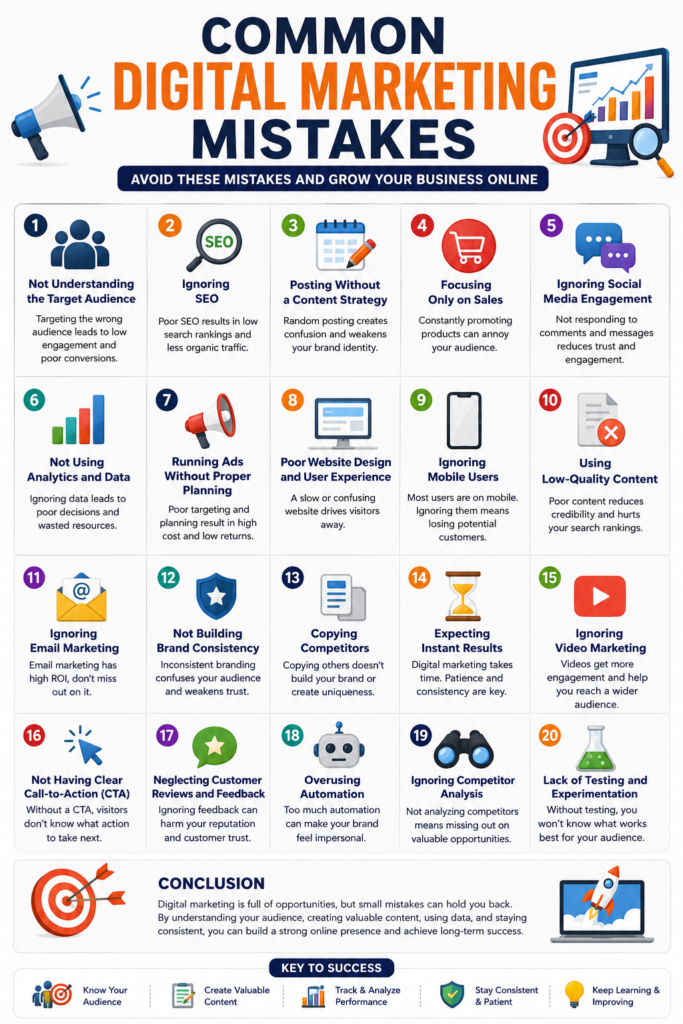
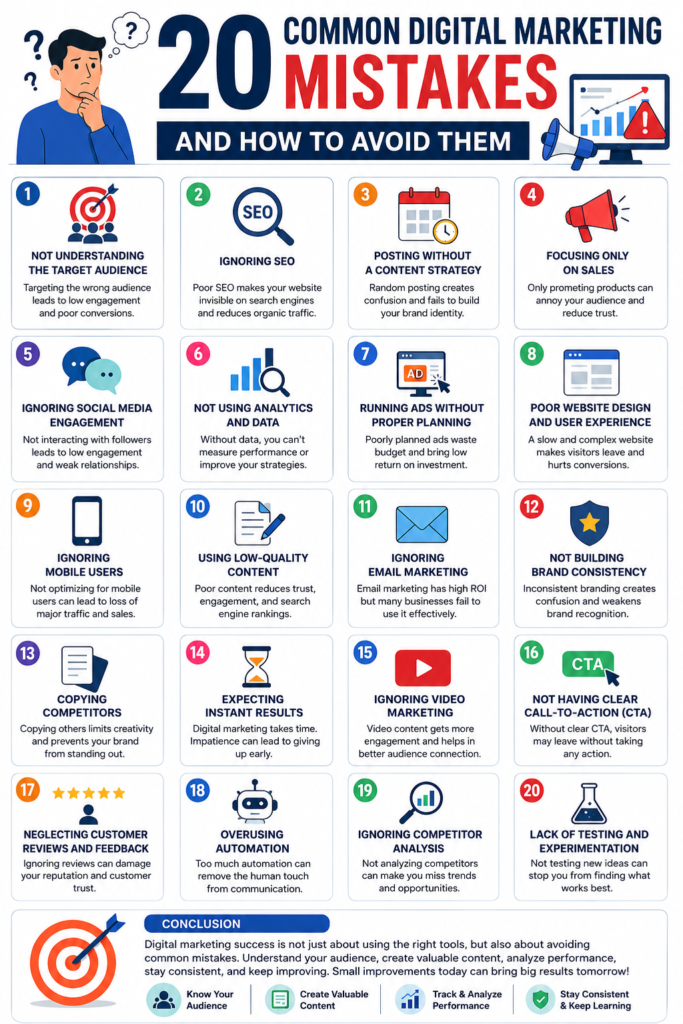
Digital marketing offers huge opportunities for businesses, but success requires proper planning, consistency, and continuous improvement. Many businesses fail not because digital marketing does not work, but because they make avoidable mistakes such as ignoring SEO, targeting the wrong audience, posting low-quality content, or expecting instant results.
By understanding these common digital marketing mistakes and applying the right strategies, businesses can improve their online presence, attract more customers, and increase long-term growth.
The key to successful digital marketing is:
- Understanding the audience
- Creating valuable content
- Tracking performance
- Staying consistent
- Continuously learning and improving
Businesses that avoid these mistakes and focus on customer value will build stronger brands and achieve better results in the digital world.